As K-dramas have become popular around the world, more people seem to be curious about what life in Korea is actually like.
If you’ve watched enough Korean dramas, you may have wondered:
“Do Koreans really live like this?”
I was born in Korea and have lived here for decades. I’ve also spent my entire life watching Korean dramas.
I’m not a drama critic or an expert on Korean culture.
I’m simply an ordinary Korean who has lived here long enough to recognize which parts of a drama make me think, “Yes, that feels familiar,” and which parts make me think, “Well… it is a drama.”
So how much of the Korea you see in K-dramas is actually real?
Quite a lot.
And at the same time, not nearly as much as you might think.
The Korea in the Background Is Often Very Real
Let’s start with something that may surprise international viewers: the places.
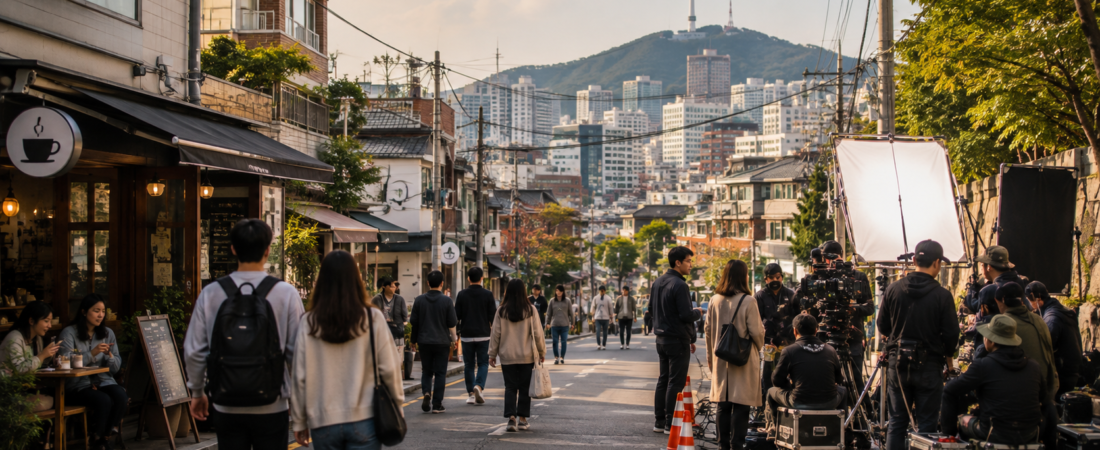
Many of the streets, restaurants, cafés, markets, neighborhoods, and buildings you see in Korean dramas are real places in Korea.
Of course, sets are used too. But productions also film in real locations all over the country.
That means living in Korea occasionally comes with a strange experience: you can simply be going about your day and run into a film or drama crew.
Sometimes part of a street is being used for filming. Sometimes people are gathered around trying to see what’s happening. And if you’re lucky, you might even spot one of the actors.
In my own experience, I’ve seen actors greet people nearby and apologize for the inconvenience caused by filming.
Moments like that can make even a famous actor feel surprisingly approachable.
There’s another funny side to watching Korean dramas when you live here.
Sometimes I’ll be watching a show and suddenly think:
“Wait. I know that place.”
A street I’ve walked down without thinking twice can look completely different on television.
Change the camera angle, lighting, weather, or time of day, and an ordinary place can suddenly look beautiful.
I actually live about a three-minute walk from a location that has appeared many times in Korean movies and dramas.
For someone overseas, a place like that might be a K-drama filming location.
For me, it’s just part of the neighborhood.
From Glamorous Seoul to Old Markets — Those Places Exist
K-dramas cover an enormous range of Korean life.
You might see the glittering streets of Seoul and expensive apartments in one show, then an old residential neighborhood, a small town, a rural village, or a traditional market in another.
Many of those environments have real counterparts in Korea.
Take Itaewon, for example.
The neighborhood featured in Itaewon Class was already one of Seoul’s best-known international areas long before the drama. But the show introduced its streets and atmosphere to an even larger global audience.
Then there are dramas such as Queen of Tears or When Life Gives You Tangerines, which show very different sides of Korea — rural landscapes, markets, villages, and life outside the center of Seoul.
A drama will obviously choose its locations carefully and make them look as good as possible.
But the world behind those scenes isn’t necessarily fictional.
Visit smaller Korean cities or traditional markets and you can still find scenes that feel surprisingly familiar.
That creates an interesting experience for Koreans watching these shows.
What might look like an exotic K-drama location to someone overseas can look to us like:
“I’ve seen somewhere like that before.”
No, Koreans Don’t All Look Like K-Drama Stars
This one I can answer with confidence.
No.
Korean actors and actresses are exceptionally attractive people.
There’s a reason millions of people around the world want to watch them.
But if you come to Korea, you are not going to find a hundred K-drama leading men walking down every street.
Then again, I doubt there are a hundred Tom Cruises walking down every street in America either.
Personally, I’m an Anne Hathaway fan.
But if I visit the United States, I’m not expecting to encounter a hundred Anne Hathaways on my way to get coffee.
Korea is no different.
Think about Squid Game.
Remember the green tracksuit Lee Jung-jae wore?
That is not exactly the kind of outfit you see ordinary Koreans casually walking around in every day.
And yet somehow, Lee Jung-jae wears it and still looks good.
That’s an actor for you.
So if you visit Korea after watching K-dramas, please don’t be disappointed when every man walking down the street doesn’t look like the lead in a romantic drama.
We’re ordinary people too.
I’m Still Waiting to Meet the Perfect K-Drama Hero
There is something even harder to find in real Korea than a K-drama star.
The perfect K-drama hero.
He’s handsome.
He’s rich.
He’s successful.
But somehow, he also has a heart of gold.
He helps people who are struggling, falls hopelessly in love with someone from a completely different world, and sometimes seems willing to give up everything for that love.
I’ve lived in Korea for decades.
I’ve met plenty of good people.
I’ve met successful people.
I’ve met kind people.
Unfortunately, I have yet to meet the man who has all of those qualities at the same time while also living out a beautiful, destiny-defying romance.
Maybe he exists.
I just haven’t met him yet.
The Humor? That Part Feels Pretty Familiar
There is one part of Korean dramas that often feels surprisingly real to me.
The humor.
K-dramas have a habit of inserting funny moments into otherwise serious situations.
Someone says something ridiculous in the middle of an emotional conversation. People tease one another when work is exhausting. A deeply serious scene suddenly becomes funny for thirty seconds.
That doesn’t feel particularly strange to me.
I’ve known plenty of people in real life who can find something to joke about even when work is difficult or things aren’t going particularly well.
People fool around at work.
Friends can be discussing something genuinely serious and suddenly burst out laughing.
I’m not saying every Korean is like this.
But in the Korea I’ve experienced, it’s familiar enough that sometimes I’ll watch a character doing something ridiculous and think:
“Yeah. I actually know someone like that.”
And Then There Is Love
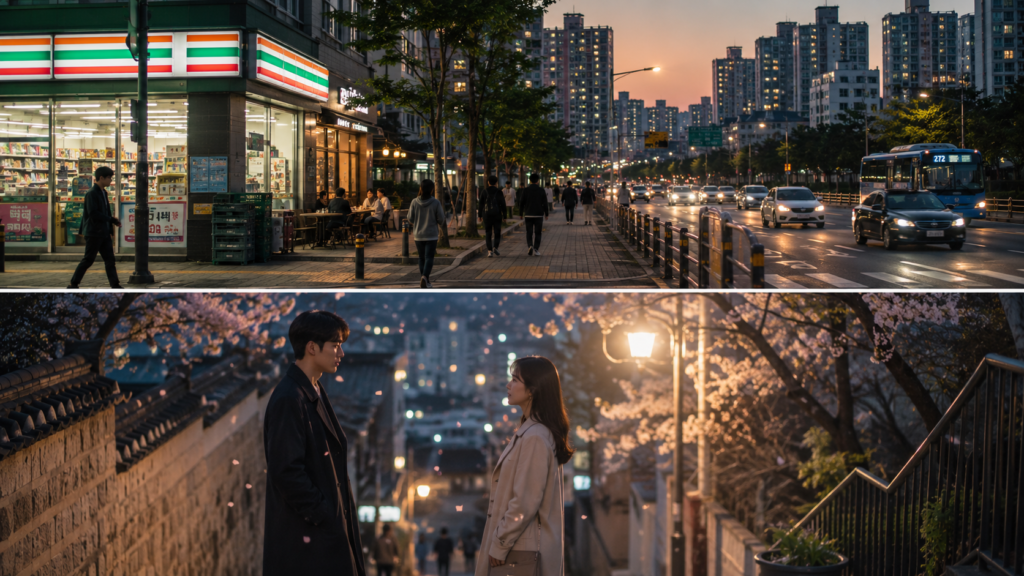
One of my favorite things about Korean dramas is the way they portray love.
A man loves a woman — or a woman loves a man — with an almost painful intensity.
They wait for each other.
They miss each other.
Sometimes they seem willing to sacrifice everything for each other.
Do Koreans really spend their everyday lives loving each other this dramatically?
Of course not.
I certainly don’t walk around witnessing scenes like that every day.
Maybe that’s part of why we watch dramas in the first place.
They let us experience a kind of love that can be difficult to find in ordinary life.
And when two characters who have struggled for an entire series finally end up together, even I sometimes feel a little warmer inside.
K-dramas have found ways to tell love stories that cross generations, age differences, social classes, and even national borders.
And apparently, humans weren’t enough.
In Guardian: The Lonely and Great God — better known internationally as Goblin — we even got a love story involving a supernatural being and a human.
At that point, I suppose Korean dramas had decided there were no boundaries left for love.
So, Are K-Dramas Realistic?
My answer is:
Some parts are surprisingly real. Others aren’t real at all.
The streets, markets, cafés, neighborhoods, and landscapes you see on screen may very well exist somewhere in Korea.
The humor can feel familiar.
The way people interact with family, friends, and coworkers can sometimes make me think, “Yes, I know that feeling.”
But no, everyone here doesn’t look like a K-drama star.
And I don’t spend my days watching handsome millionaires give up their fortunes in pursuit of true love.
Some things happen because, after all, it’s a drama.
And maybe that’s exactly why we enjoy watching them.
But behind those stories is a Korea that is much more real than you might think.
There are ordinary people walking those streets, shopping in those markets, drinking coffee in those cafés, going to work, raising families, worrying about money, laughing with friends, and simply getting through another day.
I’m one of them.
So if you’ve ever watched a K-drama and found yourself wondering:
“Do Koreans really do that?”
Ask me.
Food, dating, work, drinking, family, apartments, school — whatever you’re curious about.
I don’t speak for every Korean, and I’m not an expert on Korea.
But I can tell you what it looks like from where I live.