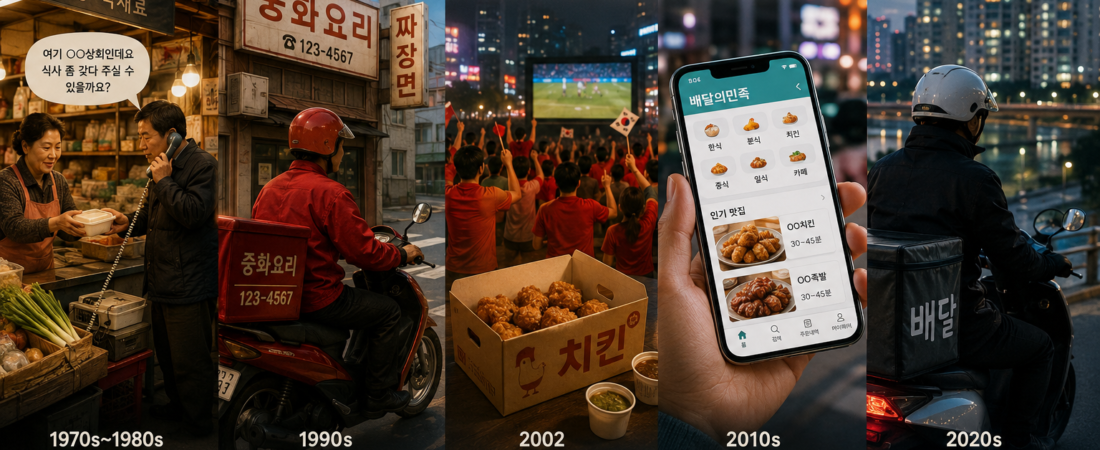
How Did Food Delivery Become So Big in Korea? A Korean’s Memories
Korean food delivery culture is such a normal part of everyday life that most of us probably don’t think much about it.
You’re hungry, so you take out your phone, choose something to eat, place an order, and wait.
A little while later, someone brings the food right to your door.
You can order late at night. You don’t always have to be at home. Depending on where you are and what’s open, food can find its way to you in all kinds of places.
To Koreans, this doesn’t feel particularly unusual.
It never did to me either.
But these days, I sometimes work as a delivery rider myself.
When I was a child, I waited for delivery food.
As an adult, I became the person ordering it on my smartphone.
And now, sometimes, I’m the person bringing it to someone else’s door.
Thinking about it that way, I’ve actually watched Korean delivery culture change for a pretty long time.
How I Remember Korean Food Delivery Culture
For a long time, I thought Korea’s food delivery culture probably began in traditional markets.
That’s just my personal impression, of course.
Traditional Korean markets were packed with merchants selling all kinds of things.
Vegetables, fish, clothes, household goods and almost anything else people needed.
But the merchants still had to eat.
If you were running a shop alone, you couldn’t simply close the store and disappear for lunch.
So you called a nearby restaurant.
“Hi, I’m at the shop over here in the market. Could you bring me something to eat?”
And the restaurant brought the food to you.
That’s one of the oldest forms of food delivery I remember seeing.
There’s also a personal reason this image is so familiar to me.
My parents were merchants.
They would order food and eat inside their shop while they worked.
So when I was a child, seeing someone bring food directly to a store didn’t seem special at all.
But while preparing this story, I discovered something interesting.
I was wrong.
Koreans had apparently been ordering food long before the markets I remember.
So traditional markets probably weren’t the beginning of Korean food delivery.
They were simply the beginning of food delivery as I remember it.
Then There Was the Jjajangmyeon Delivery Guy
When I think about delivery food from my childhood, one food immediately comes to mind.
Jjajangmyeon.
Korean-style black bean noodles.
Today, you can have an incredible variety of food delivered in Korea.
Back then, things were different.
Ordering jjajangmyeon from a Chinese restaurant on the weekend was actually something I looked forward to as a kid.
You called the restaurant.
You ordered your food.
And then you waited for the delivery guy to arrive.
This wasn’t like today’s system, where riders pick up orders from many different restaurants.
The delivery guy usually worked for the Chinese restaurant itself and delivered food from that restaurant.
Looking back, I think those Chinese restaurant delivery guys were probably the closest thing in my childhood to the delivery riders you see everywhere in Korea today.
Of course, I wasn’t thinking about any of that at the time.
I was just waiting for my jjajangmyeon to hurry up and arrive.
Then, in My Memory, Came Fried Chicken
As time passed, more kinds of food became available for delivery.
After jjajangmyeon, the next big delivery food I remember is fried chicken.
And as chicken delivery became more common, I remember something else beginning to change too.
Food didn’t necessarily have to be delivered only to your home or workplace anymore.
It could be brought to wherever you happened to be.
There’s one period that stands out particularly strongly in my memory.
The 2002 World Cup and the Delivery Culture I Remember
In 2002, South Korea and Japan hosted the FIFA World Cup.
The atmosphere in Korea was incredible.
People poured into the streets to watch football together.
And even after matches ended, people didn’t necessarily want to go home.
I remember people continuing the night afterward, sometimes heading to places like the Han River to hang out.
And wherever people gather for hours, eventually someone gets hungry.
In my memory, around this period I began to feel that delivery was changing from:
“Food comes to your house.”
to:
“Food comes to wherever you are.”
I’m not saying the 2002 World Cup created this change.
That’s not something I can prove.
It’s simply how I remember the change happening around me as someone living in Korea at the time.
But those scenes are still quite vivid in my memory.
Then Smartphones Changed Everything
I honestly couldn’t tell you exactly when the next change happened.
At some point, the number of foods we could order for delivery just seemed to explode.
And one of the biggest reasons was the arrival of food delivery apps.
In the old days, if you wanted Chinese food, you needed the phone number of a Chinese restaurant.
If you wanted chicken, you called a chicken restaurant.
Smartphones changed that completely.
Open one app and suddenly there are hundreds of restaurants in front of you.
You can look at menus.
Compare prices.
Read reviews from other customers.
Choose what you want.
Pay for it.
And you don’t even have to talk to anyone on the phone.
Food delivery gradually became an even more ordinary part of everyday Korean life.
And then something happened that changed everything again.
Then COVID Arrived
Anyone who remembers the COVID years probably remembers the atmosphere.
The news constantly told people to avoid going outside whenever possible.
Everyone wore masks.
People tried to avoid physical contact.
Some people barely left their homes at all.
But people still had to eat.
And one group of people became incredibly important during that period:
delivery riders.
They rode around the cities wearing masks and left food outside people’s doors.
Demand for delivery exploded, and there was constant talk about delivery fees and how much riders could earn.
But there’s something funny about this part of the story.
I wasn’t a delivery rider then.
I was on the other side.
I was the person sitting at home, ordering food and waiting for a rider to bring it to me.
I was the customer.
And Now I’m the One Bringing the Food
COVID eventually faded.
People started going outside again.
The delivery market changed too.
But the enormous variety of food that had become available for delivery didn’t simply disappear.
Today in Korea, you can order an astonishing range of food without leaving your home.
You can even order very late at night or in the early morning, as long as there’s a restaurant open and delivering.
And then, somehow, my own position in this story changed.
The little boy who ate delivered food at his parents’ shop…
The kid who waited excitedly for jjajangmyeon on the weekend…
The adult who ordered late-night food on his smartphone…
The customer who waited for delivery riders during COVID…
eventually became a delivery rider himself.
Sometimes I find that pretty funny.
Now I’m no longer only the person waiting for the food.
Sometimes I’m the person carrying the food that somebody else is waiting for.
And once I actually started doing this work, I began noticing things I had never seen when I was just a customer.
A surprising amount happens between the restaurant and your front door.
So in the next story, I want to look at Korean delivery culture from the other side.
Why is food delivery in Korea so fast?
This time, I’ll tell you what it looks like not from the perspective of someone waiting for dinner…
but from the perspective of the person bringing it to you.