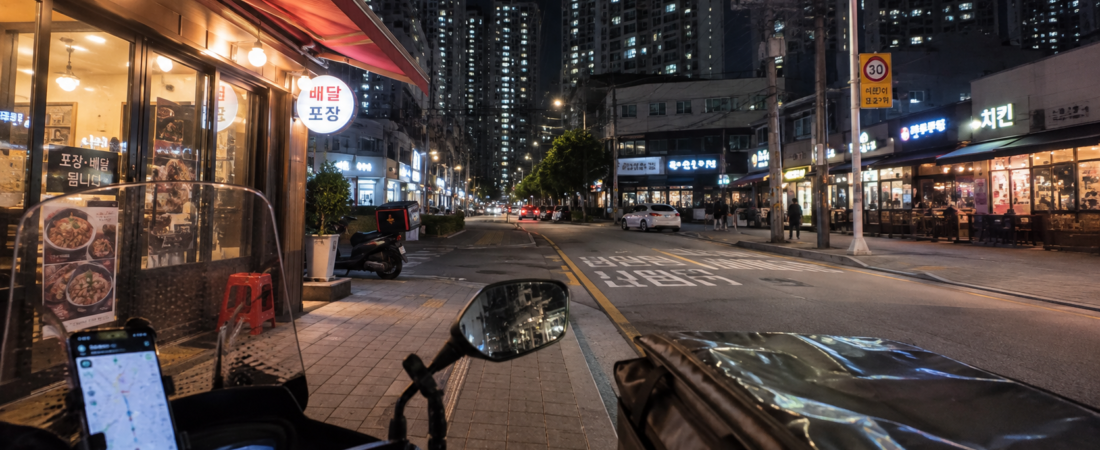
Why Is Food Delivery So Fast in Korea? A Delivery Rider Explains
In my previous story, I wrote about how Korean food delivery culture changed from the delivery food I remember as a child to the app-based system we have today.
This time, I want to tell the story from the rider’s side.
One thing that seems to surprise foreigners in Korea is food delivery.
Food sometimes arrives much faster than they expect.
People are surprised that they can order so late at night.
And sometimes they’re surprised by just how many different things can be delivered.
I can look at this question from a slightly unusual perspective.
Because these days, I sometimes deliver the food myself.
So rather than giving you an explanation of Korean delivery culture that I found somewhere on the internet, I want to tell you what I actually see when I pick up someone’s food and take it to their home.
Why is Korean food delivery so fast?
Well, there isn’t just one reason.
Why Is Food Delivery So Fast in Korea? Start With Distance
There’s no single answer.
Every delivery is different.
Sometimes a delivery is ridiculously close.
I’ve had deliveries where the distance was less than 100 meters.
Close enough to make you think:
“I could almost just walk this over there.”
Other deliveries can take me 7 or 8 kilometers.
Naturally, delivery fees vary depending on things like distance and conditions.
So it wouldn’t be accurate to say Korean delivery is fast simply because every restaurant is right next door to the customer.
That’s not always true.
But after doing this work for a while, you start noticing a pattern.
Restaurants and Customers Are Packed Very Close Together
Korea isn’t a geographically large country.
And in Korean cities, huge numbers of people live close together.
There are apartment complexes everywhere.
There are also areas where restaurants are packed together in relatively small commercial districts.
When I’m working, I notice a fairly predictable pattern.
If I’m near an area with lots of restaurants, delivery requests keep coming in.
I pick up food there.
Then I take it to a nearby residential area filled with apartments and houses.
Then another pickup.
Then another residential area.
After doing this for a while, you often find yourself picking up food in similar areas and delivering it to similar clusters of homes.
In my experience, this density is one of the biggest reasons food delivery can be so fast in Korea.
Restaurants and huge numbers of customers simply aren’t that far apart in many Korean cities.
How Many Deliveries Can I Make in an Hour?
Personally, I usually complete around three to five deliveries per hour when I’m working.
That doesn’t mean I can always do that.
It depends on how many orders there are, how far I have to travel, traffic conditions and whether the food is ready when I arrive.
I’ve heard of riders completing six or even seven deliveries in an hour when orders are coming in heavily and conditions are right.
But there’s one thing even the fastest rider can’t control.
The food has to exist before we can deliver it.
Sometimes We Just Stand There and Wait
Korean delivery riders commonly use the expression jori-daegi.
It basically means waiting for the food to be prepared.
I arrive at the restaurant…
but the food isn’t ready yet.
So I wait.
In my own experience, maybe one out of every two or three pickups involves at least some waiting.
And naturally, the longer the cooking takes, the longer the total delivery takes.
That’s something customers don’t always see.
If your food arrives late, it doesn’t necessarily mean your rider was slowly wandering around somewhere.
The rider might already have been standing inside the restaurant while your dinner was still in the frying pan.
On the other hand, if I arrive and the food is already packed and waiting?
Pick it up.
Get moving.
That difference can save a surprising amount of time.
Delivering to Korean Apartments Is Actually Pretty Convenient
Korea has a lot of apartments.
A lot.
From the outside, you might imagine that delivering to one specific apartment inside a huge complex would be a nightmare.
Sometimes an unfamiliar complex can be confusing.
But Korea’s delivery system has adapted pretty well to apartment living.
Apartment buildings may have ways for visitors or delivery workers to gain access, and customers can leave the necessary entry instructions with their order.
When the instructions are clear, I can enter without standing outside wondering how I’m supposed to get in.
And apartments have another enormous advantage for a delivery rider:
elevators.
I don’t have to climb all those stairs.
That’s wonderful.
There is, however, a downside.
Elevators are slower than you think.
If I’m delivering to a high floor, or if the elevators are busy, I can spend quite a bit of time just waiting.
Sometimes the trip from the restaurant to the apartment building is quick…
and then getting from the lobby to the customer’s front door takes surprisingly long.
That’s one of those tiny details you don’t really notice until you actually do this job.
Is Korean Delivery Fast Because Riders Drive Like Crazy?
I think the answer is:
Half yes. Half no.
Delivery riders are just people.
Some move slowly.
Some move quickly.
Some are probably in more of a hurry than others.
And yes, customers sometimes complain when a delivery takes too long.
Speed does matter.
But I don’t think it’s accurate to explain Korea’s delivery speed simply by saying:
“Korean delivery riders drive insanely fast.”
There are too many other pieces involved.
The distance between the restaurant and the customer.
The density of the city.
The delivery app.
How long the food takes to cook.
Where the rider happens to be.
Traffic.
Getting into an apartment building.
Waiting for the elevator.
All of those things have to work together.
A rider simply driving faster can’t solve everything.
And more importantly, dangerous driving shouldn’t be considered a normal or necessary part of food delivery.
But There’s Another Reason I Want to Deliver Food Quickly
Everything I’ve talked about so far is about the system.
But from my perspective as the person carrying the food, there’s another reason I don’t want to take too long.
Imagine you’ve ordered noodles.
The restaurant finishes cooking them.
Then the delivery takes too long.
Ten minutes.
Twenty minutes.
Thirty minutes.
What’s happening to those noodles?
They’re getting soggy.
By the time you receive them, you might be paying good money for food that no longer tastes the way it should.
You might feel like you’ve wasted your money.
You might even get angry.
I understand that feeling.
Because I like ordering delivery food too.
When I’m working, I’m a delivery rider.
But when I finish work, I’m a customer again.
I order late-night food too.
I wait for my delivery too.
I want hot food to still be hot.
I want noodles to arrive before they’re ruined.
So once I’ve picked up someone’s order, I want to get it to them while it’s still in good condition.
I usually don’t know the person I’m delivering to.
Most of the time, I don’t even see their face.
These days, I often just leave the food outside the door.
But sometimes, as I’m putting the food down, I think:
I hope they enjoy this.
I hope the food still tastes good.
And maybe I hope it makes their evening just a little bit better.
There are plenty of technological and logistical reasons why Korean food delivery can be so fast.
But behind all of those apps, motorcycles, restaurants and apartment buildings, there are also ordinary people.
The person ordering the food is a person.
The person bringing it is a person too.
And the funny thing is that those roles can switch at any moment.
The delivery rider who brings your dinner tonight might finish work, go home, order something to eat and wait for another rider to bring his dinner.
I know.
Because I do exactly that.
What’s food delivery culture like where you live?
Is it anything like Korea?
Or is it completely different?