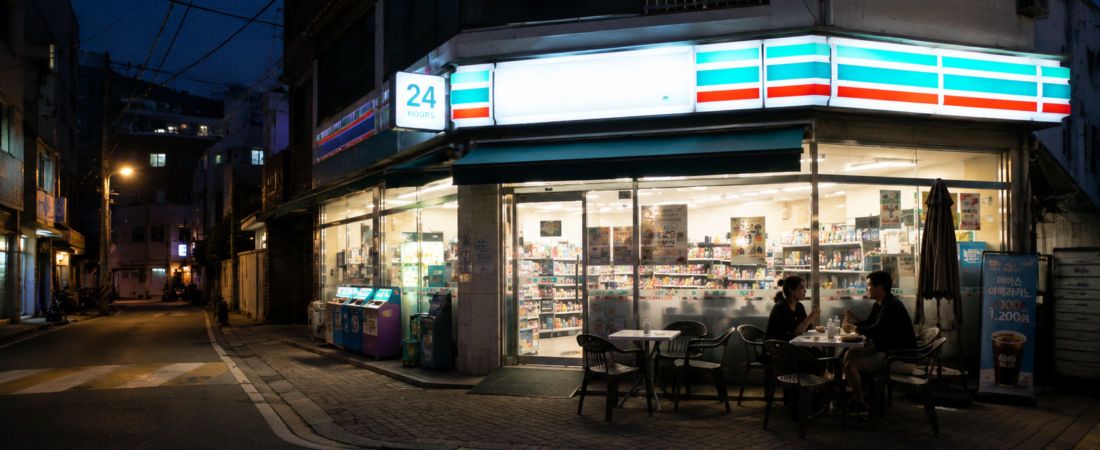
I sometimes go to a convenience store several times in a single day.
I might stop by for a drink, cigarettes, or alcohol. Sometimes I go because my child wants a snack. Other times, I need to quickly ship something I sold secondhand.
If you ask me why I go to convenience stores so often, it’s actually hard to list every reason.
They’re simply too deeply woven into my everyday life.
To someone visiting Korea, a Korean convenience store might seem like a unique experience. You can cook instant ramen, buy a full lunchbox or samgak gimbap (triangular rice wrapped in seaweed), and pour a drink over a cup filled with ice.
But to me, someone who lives here, a convenience store isn’t a tourist attraction.
It’s just part of everyday life.
And at this point, I think Korean convenience stores have become so essential that life here would be surprisingly difficult without them.
The Convenience Stores I Remember as a Kid
In my memory, convenience stores haven’t fundamentally changed.
They were always bright little stores selling snacks, bread, chocolate, drinks, alcohol, and cigarettes.
But one thing has definitely changed.
There’s a lot more food now.
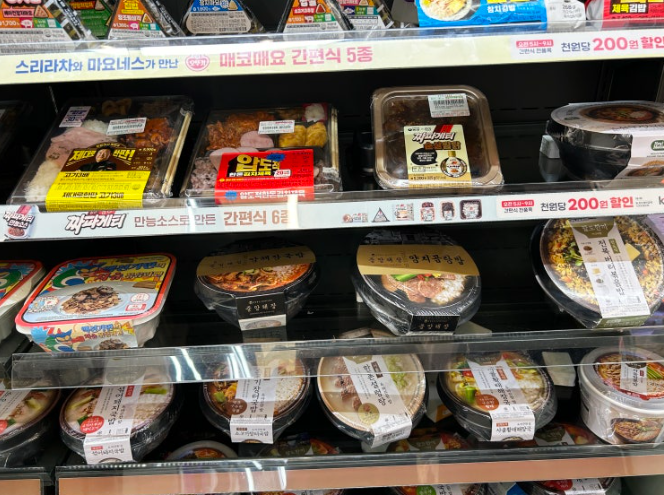
When I was younger and hungry, the choices were mostly bread, snacks, or cup ramen. Today, it’s completely different.
You can find full lunchboxes, pasta, tteokbokki (spicy rice cakes), eomuk-tang (fish cake soup), samgak gimbap, hamburgers, and all kinds of ready-to-eat meals.
Many of them only need a few minutes in a microwave. Compared with the convenience store food I remember from years ago, both the variety and quality have improved dramatically.
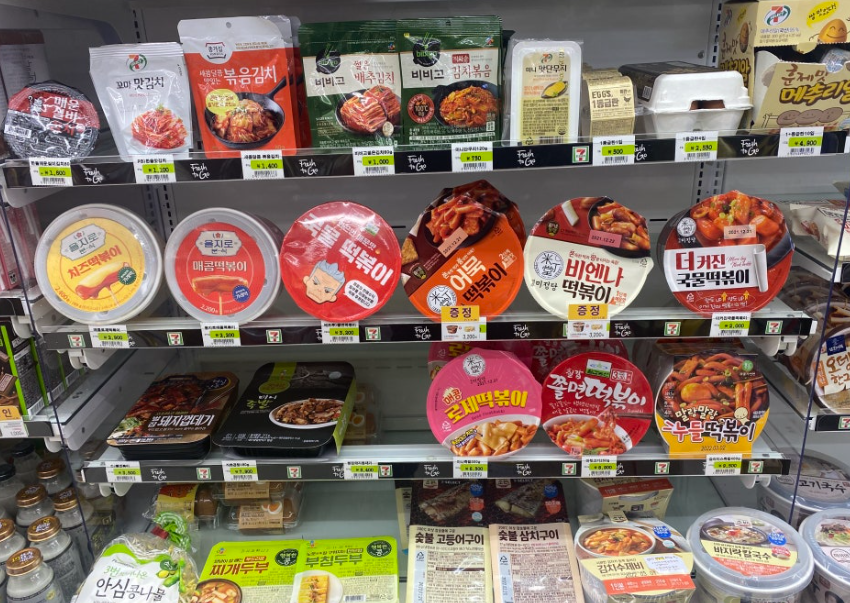
Eating one of your daily meals at a convenience store isn’t unusual anymore.
And it’s definitely not just me.
Someone might stop after work because they’re starving, eat a cup of ramen, and then continue home. A delivery driver or courier might stop between jobs and grab some bread and milk.
I do that myself.
When I’m working a delivery side job and get hungry, I often stop at a convenience store for bread and milk.
It’s quick, easy, and there’s almost always a convenience store nearby.
Of course, prices have gone up a lot.
These days, I sometimes pick up a few things and get surprised when I see the total at the register. I understand that prices in general have risen, but convenience stores definitely feel more expensive than they used to.
Eating a Meal Inside a Korean Convenience Store
Many Korean convenience stores have a small area where customers can eat what they buy.
There are usually microwaves, and hot water is available for instant ramen.
For Koreans, none of this feels particularly unusual.
But there’s another small detail that foreign visitors might find interesting.
Food waste.
Everyone eats a different amount.
Some people finish every drop of broth from their cup ramen. Others eat the noodles and leave most of the soup behind. You might also have some rice or other food left over from a meal.
That’s why many convenience stores have more than just a regular trash can.
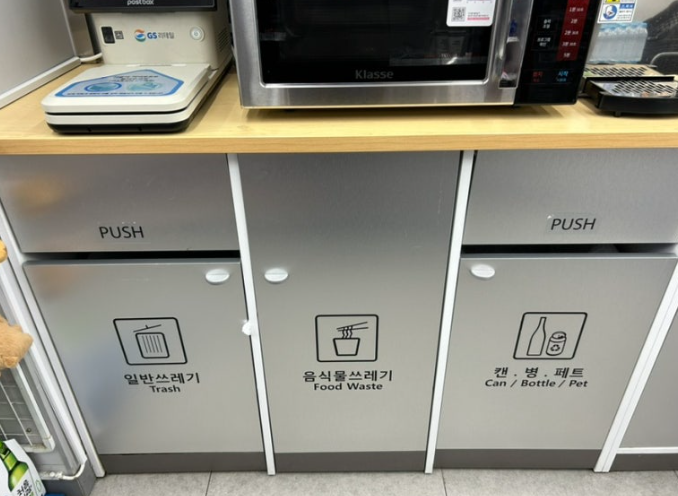
You’ll often find separate places for general waste and recyclables such as plastic, bottles, and cans, as well as a separate container for leftover food and liquids.
After eating cup ramen, throwing away the leftover broth and sorting the container before leaving feels completely ordinary when you live in Korea.
But maybe these tiny, ordinary moments are exactly what show real Korean daily life best.
Convenience Stores and Drinking Go Hand in Hand
If you asked me to choose just one memory involving alcohol and convenience stores, I’d actually have trouble picking one.
Korean drinking culture and convenience stores naturally cross paths in all kinds of ways.
Before going out drinking, I might stop at one to buy a hangover drink. After drinking, I might walk into a convenience store completely drunk and somehow come out with a ridiculous amount of snacks and drinks.
Then I wake up the next morning and wonder why I bought all of it.
It’s also common to see people drinking at tables outside convenience stores in Korea.
You buy a few bottles or cans of soju or beer, grab some simple snacks, sit outside, and talk with your friends.
I like that atmosphere too.
You don’t necessarily need to go to a restaurant or bar.
On a summer night, sitting outside a convenience store with a cold beer can be a perfectly good night out.
I’m not entirely sure why Koreans enjoy those little outdoor tables so much.
But sometimes they remind me of summers by the Han River when I was younger.
Back then, I remember people setting up tents, grilling meat, and spending summer nights by the river.
Sometimes I wonder whether Korea’s convenience-store table culture is somehow connected to that long-standing enjoyment of eating and drinking outside.
That’s just my personal thought.
But when I see people sitting around a little convenience-store table on a summer night, that’s what sometimes comes to mind.
A Convenience Store Is More Than a Place to Buy Things
It’s easy to think about food and drinks when talking about convenience stores.
But to me, they serve a much bigger role.
When a sudden summer rainstorm hits, you can duck inside for a moment.
On a freezing winter night, you can step inside and warm up.
And when you’re walking down a dark street late at night, seeing the bright lights of a convenience store in the distance can somehow make you feel a little more at ease.
There’s an employee inside. Other people may be around. The entire store is brightly lit.
For a child or a woman walking alone on a dark street, I think simply having a brightly lit convenience store nearby can make the street feel a little less frightening.
Sometimes I think of convenience stores as small lights glowing in Korea’s dark streets.
Of course, I’m not saying that a convenience store guarantees anyone’s safety.
I’m talking about the feeling it gives me.
Knowing that these brightly lit stores are scattered throughout Korean neighborhoods and stay open late into the night can provide a small sense of reassurance.
You Notice Convenience Stores Most When There Isn’t One
When you live in Korea, convenience stores are so common that it’s easy to forget how much you rely on them.
I usually realize it when I travel.
Every once in a while, I’ll go on a summer vacation or visit a quiet rural area where there isn’t a convenience store nearby.
And I hate it.
Suddenly, buying a bottle of water isn’t so easy. If my child wants a snack or we need a drink, we can’t just walk down the street and get one.
If we suddenly need some small everyday item, we’re out of luck.
That’s when I realize how much I normally take convenience stores for granted.
Having just one missing from the neighborhood can make everyday life surprisingly inconvenient.
That’s why I think convenience stores have become something Korea simply can’t do without.
They’re there throughout the year, with many staying open late into the night or around the clock.
They’re places where you can grab a quick meal, ship a package, or buy something you suddenly need.
You can escape the rain for a moment or get out of the winter cold.
You can sit outside with a friend and have a beer.
For someone visiting Korea for the first time, cooking ramen inside a convenience store might be a fun Korean travel experience.
But for those of us who actually live here, convenience stores are something much more ordinary.
And because they’re so ordinary, they’re also much more important.
We don’t walk into a convenience store thinking we’re experiencing Korean culture.
We go in because we need a drink.
Because we’re hungry.
Because our child wants a snack.
Because we need to ship a package.
And then we walk back out and continue with our day without giving it much thought.
Maybe that’s what makes Korean convenience stores truly special.
They’re so close to us, and we use them so often, that we don’t even think about how unusual they might look to someone from somewhere else.
That’s what a Korean convenience store is to me.
Something so ordinary that I rarely think about it—but something I’d immediately miss if it were gone.