Why is Korean culture so popular? As a Korean who has watched this change happen from inside Korea, I sometimes ask myself the same question.
The first time I remember something Korean becoming enormously popular overseas, it wasn’t BTS.
It wasn’t Psy, either.
It was Bae Yong-joon.
I remember constantly hearing that the Korean actor had become incredibly popular in Japan because of the drama Winter Sonata.
Back in Korea, people even talked about how much he had done for the country’s image abroad. There were also frequent stories about Japanese tourists becoming interested in Korea and visiting because of him.
At the time, I remember thinking:
Wow. He really must be popular.
I found it a little fascinating.
But that was about it.
I don’t think I saw it as some huge phenomenon of “Korean culture becoming popular around the world,” the way we might describe it today.
After that, I would occasionally hear that another Korean celebrity or drama was doing well overseas.
Most of the time, my reaction was simply:
Oh, really?
Then there were a few things big enough that I remember them clearly.
The Korean drama Boys Over Flowers was one.
And then came Psy’s Gangnam Style.
That was different.
Calling it a global phenomenon hardly felt like an exaggeration.
But strangely enough, I didn’t really understand why.
It was definitely a fun, energetic song.
But I remember thinking:
Why is everyone going this crazy over it?
That was my reaction as a Korean watching it happen from Korea.
At Some Point, People Started Becoming Curious About Korea Itself
From what I remember, after Gangnam Style, it seemed like more foreigners started looking into Korea and actually coming here.
And gradually, something changed.
It was no longer just one Korean singer becoming popular overseas.
It wasn’t just one Korean drama either.
People were listening to K-pop, watching Korean dramas, wanting to try Korean food, and thinking about traveling to Korea.
Now, people are even curious about things that seem completely ordinary to me—Korean convenience stores, drinking culture, how we eat certain foods, and other parts of everyday life.
These are things I have lived with for so long that I never thought of them as particularly special.
Sometimes I still find it fascinating.
There are even foreigners who know far more than I do about certain Korean singers or dramas.
So why did Korean culture become this popular?
I’m not a cultural expert, and I haven’t studied the reasons professionally.
I can’t give you a definitive answer.
But as a Korean who has spent his life here, I do have my own thoughts.
I Don’t Think K-Pop Explains Everything
There is no question in my mind that Korean entertainers have played an enormous role.
Without K-pop, Korean dramas, and Korean movies, it probably would have taken much longer for so many people around the world to become curious about a country called Korea.
They opened a very big door.
But I sometimes wonder whether that alone can explain what has happened since.
Liking Korean music and becoming interested in Korea itself are slightly different things.
Someone might discover Korea through a singer or a drama.
But then that person starts looking for Korean food.
They become curious about how Koreans live.
And eventually, some of them get on an airplane and come here themselves.
Why does the interest continue that far?
I think one part of the answer may be the way Koreans treat other people.
This is only my personal opinion.
I’m certainly not saying that every Korean is kind.
I’m talking about something I have experienced naturally throughout my own life in Korea.
When I Visited a Friend’s House, They Fed Me
When I was a child, I would sometimes go to a friend’s house to play.
We would keep playing, and eventually it would be time for dinner.
My friend’s mother wouldn’t tell me that dinner was ready and I should go home.
She would simply prepare food for me too.
And I would sit down and eat with my friend’s family.
My parents didn’t think there was anything unusual about that.
The opposite was true as well.
If a friend was playing at our house when it was time to eat, we wouldn’t send him home because dinner was starting.
My mother would prepare food for him too.
At the time, I never thought of this as hospitality.
It was simply normal.
Koreans also often ask each other:
“밥은?”
Or:
“밥 먹었어?”
Literally translated, that’s something like:
“Have you eaten?”
It might sound like an odd greeting in English.
But when a Korean asks whether you have eaten, it doesn’t always mean we actually want to know what you had for lunch.
Sometimes it is simply a familiar way of showing concern for someone.
Maybe what I think of as the Korean desire to take care of others begins with little things like this.
When Someone Is in Trouble, People Often Step In
Every now and then, stories circulate online in Korea about ordinary people helping someone who is in trouble.
There are stories about people rushing over to help when something happens on the road, or restaurant owners giving food to someone who is struggling.
Of course, a few stories like these cannot represent every Korean.
There are kind people in Korea, and there are unkind people too.
But when I see these stories, they don’t feel completely disconnected from the Korea I have experienced throughout my life.
When someone is our guest, we tend to want to treat them well.
When someone appears to be in trouble, many people feel an urge to help somehow.
I think that kind of basic consideration for other people is relatively natural in Korean society.
But a Korean Might Also Take a Step Back When a Foreigner Approaches
There is also a funny contradiction.
Imagine a Korean standing on the street when a foreigner suddenly starts walking toward them.
Some Koreans might instinctively take a step backward.
In my personal opinion, there can be two reasons.
The first is very simple.
English.
A foreigner is approaching.
Are they going to speak English?
Will I understand them?
Will I be able to answer?
A lot can go through someone’s mind in a few seconds.
The second reason has less to do with language.
It may simply be a defensive reaction to an unexpected person suddenly approaching you.
Why are they coming toward me?
What do they want?
That small moment of uncertainty can make someone instinctively become cautious.
From the foreigner’s perspective, I can imagine how that might feel.
Is this person trying to avoid me?
So I don’t think Korean kindness should be described as everyone eagerly approaching strangers with a smile and offering to help.
Sometimes we can be pretty awkward too.
If You Come to Korea, I Hope You See It at Night
When I watch interviews with foreigners talking about their experiences in Korea, there is one thing that has stayed in my mind.
The night.
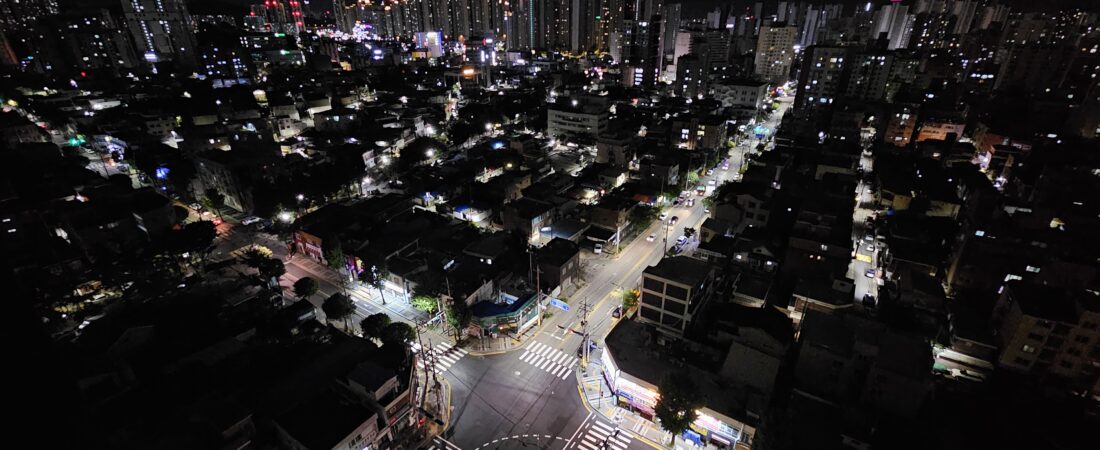
Korean cities don’t seem to go dark easily.
There are signs and businesses still glowing late into the night, and people are still out on the streets.
Of course, I’m not saying that everywhere in Korea is perfectly safe at every hour.
No country is.
But as someone who has lived in Korea, simply being outside late at night or even in the early hours of the morning doesn’t feel particularly unusual to me.
Koreans eat late.
We drink late.
We stop at convenience stores.
And we walk home.
My own family did exactly that recently.
We had dinner, ate bingsu for dessert, and then walked home at night.
In the distance, apartment buildings filled the skyline with lights.
To me, it was an ordinary scene.
But I sometimes wonder if an ordinary Korean night like that might be one of the things a first-time visitor remembers.
If I Could Tell an American Curious About Korea Just One Thing
While thinking about this article, I was asked a question:
If you could say just one thing to an American who is interested in Korea, what would it be?
It made me think.
Should I talk about K-pop?
Korean food?
Seoul?
Korean hospitality?
After thinking about it, the answer that came to mind surprised even me.
“There are no guns in Korea.”
Now, that isn’t literally true.
South Korea has a military and police force, and civilian firearm possession is possible under strict licensing and storage rules.
That wasn’t what I meant.
What I meant was much simpler:
For an ordinary person like me, guns are not part of everyday life.
When I walk down the street, I don’t look at people while wondering whether one of them might be carrying a gun.
When I walk home late at night, encountering someone with a gun isn’t something that normally enters my mind.
It is such an ordinary part of my life that I rarely think about it at all.
And yet, when I was asked to explain Korea to an American in just one sentence, strangely enough, that was the first thing that came to mind.
Why Is Korean Culture So Popular? Maybe It Isn’t Just “K-Culture”
I still can’t explain exactly why Gangnam Style became such an enormous global phenomenon.
I can’t fully explain why Korean dramas are loved around the world.
And I’m certainly not qualified to analyze the success of K-pop.
But one thing has clearly changed.
The Korea I remember from the days when I first heard about Bae Yong-joon’s popularity in Japan is not the Korea the world sees today.
People aren’t just listening to Korean music anymore.
They’re eating Korean food.
They’re traveling to Korea.
They’re curious about how Koreans actually live.
And sometimes I wonder whether what they discover along the way goes beyond the things we deliberately label “K-culture.”
Preparing one more bowl of rice because your child’s friend happens to be at your house.
Trying not to walk past someone who seems to need help.
Getting nervous and taking a step backward when a foreigner unexpectedly approaches you.
Eating, drinking, and walking home through a city that is still glowing late at night.
None of these things feel particularly special to me.
Maybe that’s why the global popularity of Korean culture still feels a little strange sometimes.
The ordinary life I have taken for granted for my entire life is now something someone on the other side of the world wants to understand.