Korean BBQ in Korea wasn’t what we planned to eat that evening. In fact, we had absolutely no plans to eat Korean BBQ at all.
It was the last day of our vacation. My wife was going back to work the next morning, and we had spent most of the day relaxing at home.
Around dinnertime, she suggested going out for tteokbokki and fried snacks.
The plan was simple: eat dinner, take a walk around a nearby park, and head home.
So the three of us—my wife, our child, and me—left the house.
When we got to the place, though, it was closed.
Of course, we had picked its day off.
I was a little disappointed because I had wanted to try the food there.
Then my wife remembered a charcoal BBQ restaurant nearby.
We moved to this neighborhood about a year ago, and we had noticed the restaurant not long after moving here. Every time we passed it, it seemed busy, and the prices looked relatively affordable.
It was one of those neighborhood restaurants we had been meaning to try someday.
And it happened to be close to the tteokbokki place.
“Why don’t we just go there?”
And just like that, our dinner changed from tteokbokki to Korean BBQ.
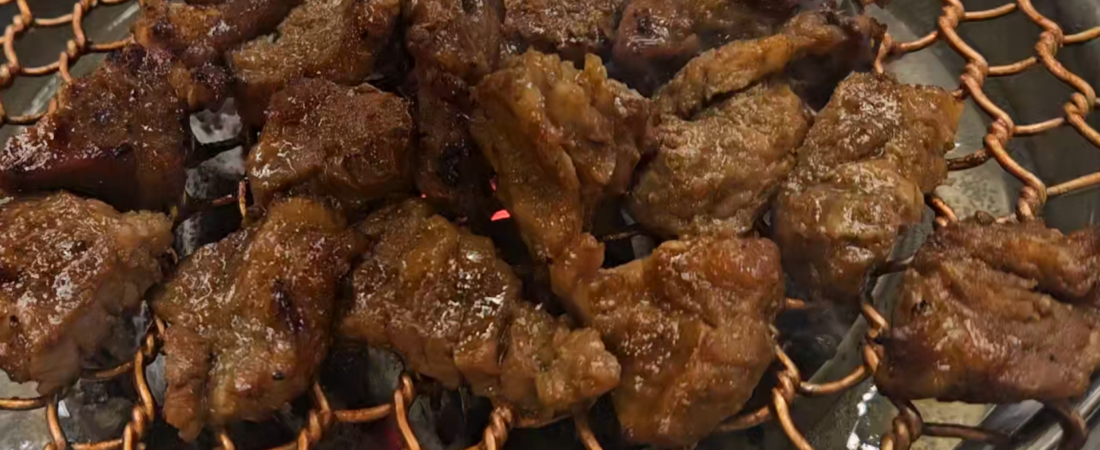
We Ordered Four Servings of Dwaeji Galbi
There were three of us, and we ordered four servings of dwaeji galbi (돼지갈비).
Dwaeji galbi is a popular type of Korean BBQ made with pork marinated in a sweet, savory sauce.
Because of that sweet marinade, it’s a flavor that both adults and children can easily enjoy. Our child loves dwaeji galbi and can easily finish a full serving now.
So four servings for the three of us didn’t feel like an unusual amount.
Soon, a container of hot charcoal was placed in the center of our table.
A grill went over it, and we cooked the marinated pork ourselves.
Marinated meat needs a little attention while it’s cooking. Because the sauce contains sugar, it can burn fairly easily over the heat.
You turn the meat as it cooks, cut it into bite-sized pieces, and keep cooking until it’s ready to eat.
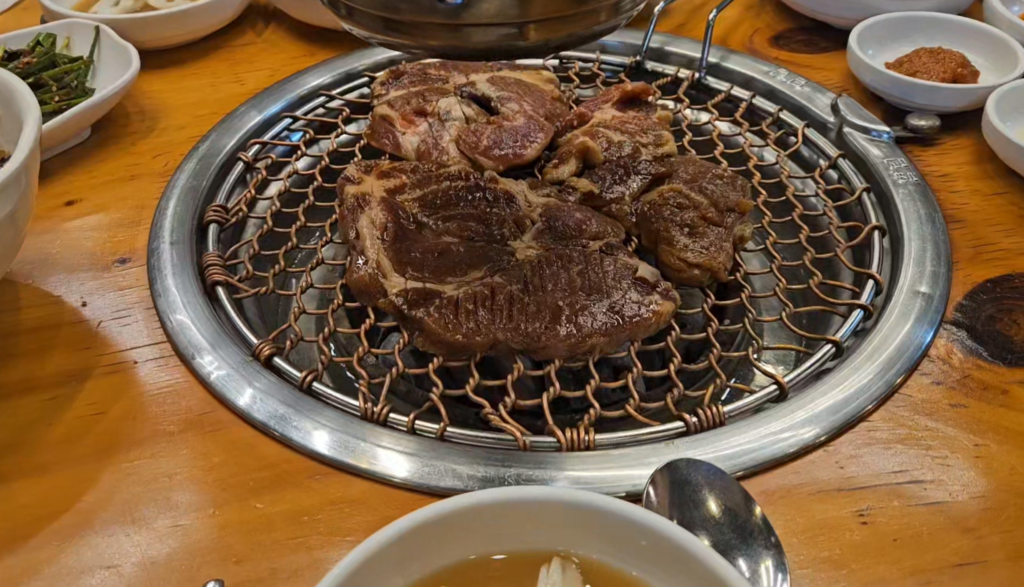
In a Korean BBQ restaurant, all of this is simply part of the meal.
Why Are There So Many Vegetables on the Table?
If you’re having Korean BBQ for the first time, all the little dishes covering the table might be almost as interesting as the meat itself.
Kimchi, side dishes, garlic, sauces, and vegetables for wrapping the meat all arrive at the table.
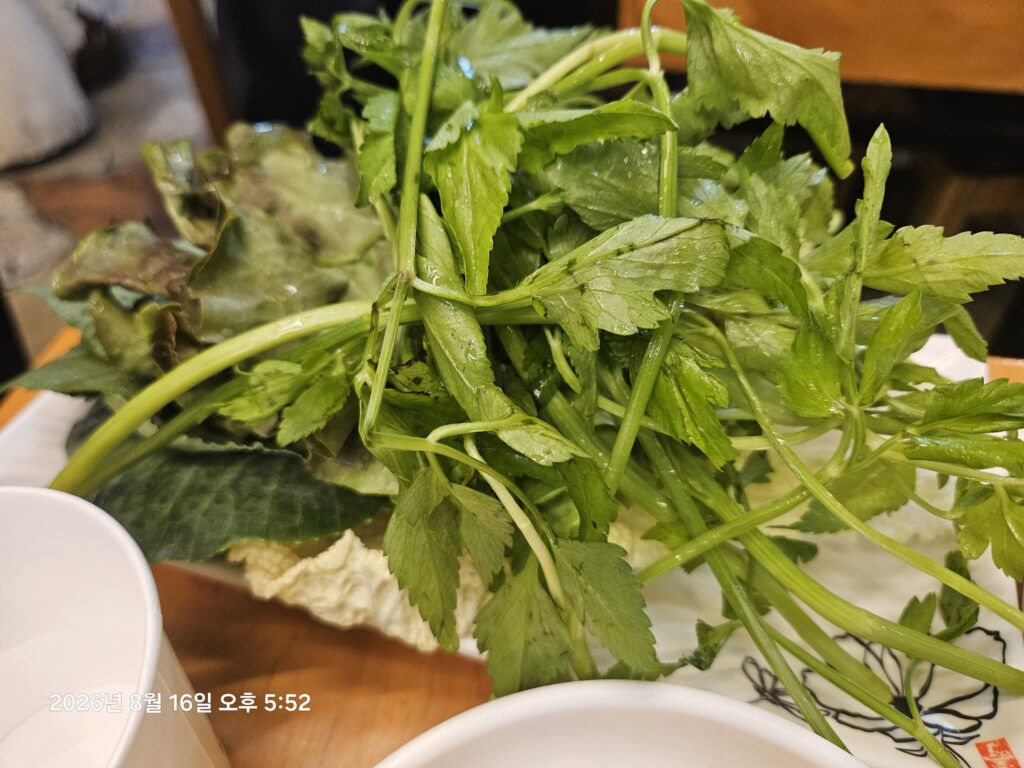
The vegetables used for wrapping food are commonly called ssam chaeso (쌈채소)—literally, vegetables for ssam.
At a typical Korean BBQ restaurant, lettuce and perilla leaves are probably the two most familiar choices.
The restaurant we visited that night was a little different.
It gave us a surprisingly wide variety of vegetables.
You don’t necessarily get this many types of ssam vegetables at an ordinary Korean BBQ restaurant, so even I found it interesting.
There are restaurants in Korea called ssambap restaurants (쌈밥집) that specialize in meals built around rice, meat, and many different kinds of vegetables for wrapping. Those places tend to offer a much wider selection.
But this wasn’t a ssambap restaurant.
It was just a neighborhood pork BBQ restaurant.
So I tried wrapping the meat in several different vegetables as we ate.
Do Koreans Always Wrap Korean BBQ in Lettuce?
When people think about Korean BBQ, they often picture someone wrapping a piece of meat in a lettuce leaf.
And yes, we eat it that way a lot.
But you don’t have to.
At least, I don’t.
I like eating things simply, so quite often I’ll just take a well-grilled piece of meat, dip it in sauce, and eat it.
What you dip the meat into also varies.
It might be ssamjang, a gochujang-based sauce, or simply salt, depending on the meat and the restaurant.
When I feel like eating some vegetables, I’ll make a ssam.
Put a lettuce or perilla leaf in your hand, add a piece of meat, maybe a little rice, some sauce or garlic, and eat the whole thing in one bite.
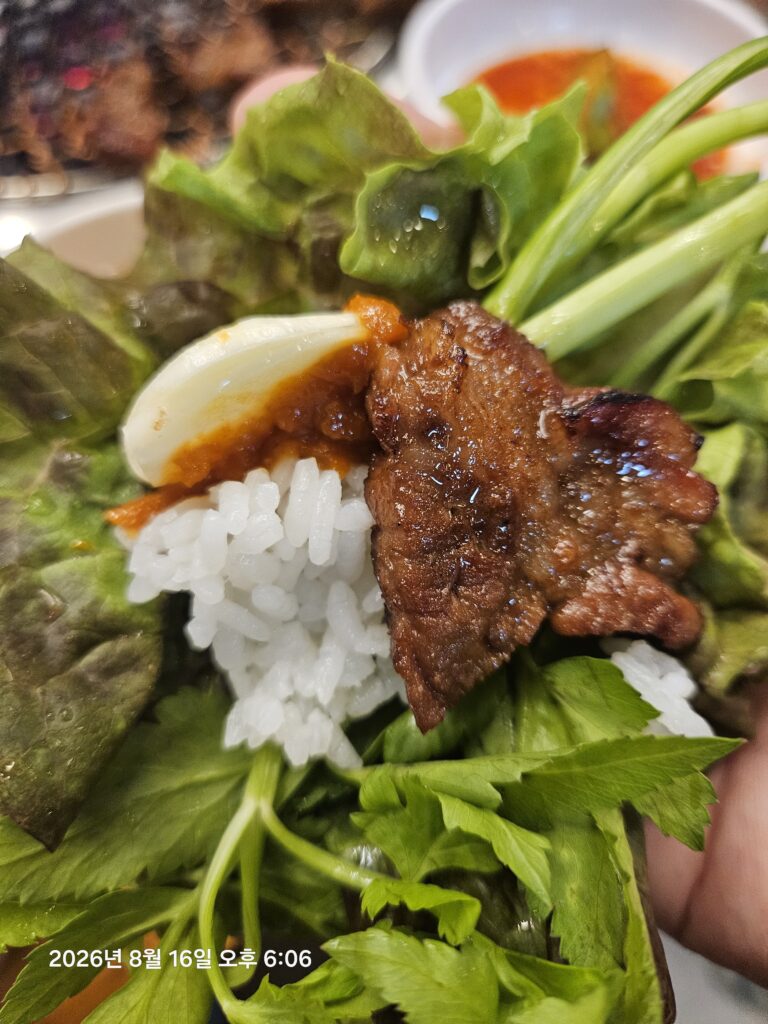
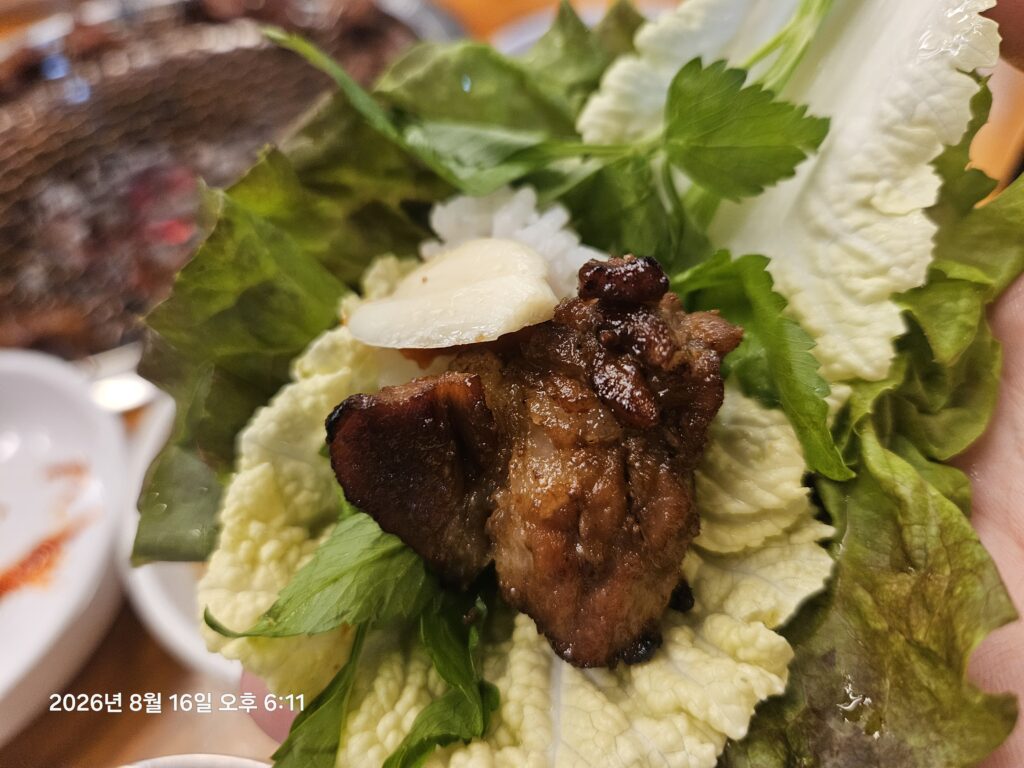
There isn’t one correct formula.
If you want rice, add rice.
If you just want meat, that’s fine too.
Even my wife and I eat the garlic differently.
I like raw garlic.
She prefers hers grilled.
We’re sitting at the same table eating the same meat, but each of us ends up making the bite we like.
For me, that’s part of the fun of eating ssam.
For Me, Korean BBQ at Dinner Naturally Goes With Soju
We also ordered soju and beer with our dinner.
I almost always drink soju.
I don’t particularly like beer, and there are years when I probably drink only two or three cans of it.
My wife is a little different.
When the two of us drink with a meal, she often starts with somaek (소맥)—a mix of soju and beer—and then switches to soju.
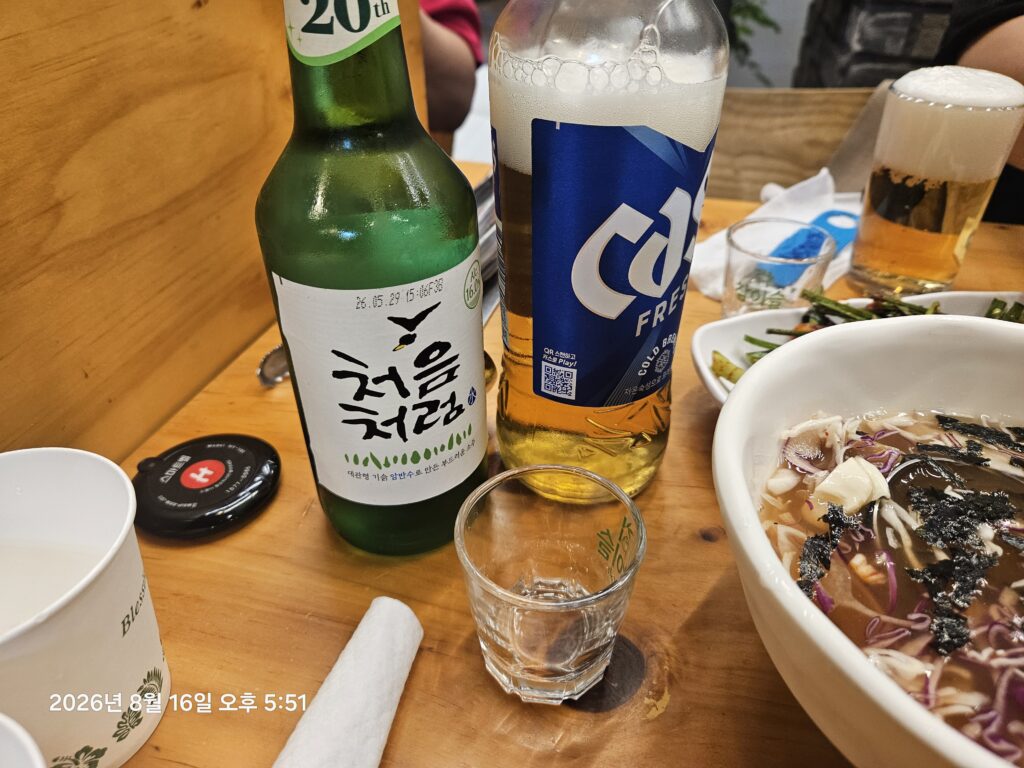
That doesn’t mean all Koreans drink this way.
It’s simply how the two of us tend to drink.
I’ve written more about how drinking fits into everyday life in Korea in my post about Korean drinking culture.
For me, though, there’s an even stronger connection between meat and alcohol.
Eating a meat dish for lunch without drinking alcohol feels completely normal.
But going to a Korean BBQ restaurant for dinner, sitting in front of a charcoal grill, cooking meat and not having a drink?
Something feels missing to me.
If I’m going out for grilled meat at night, soju naturally comes to mind.
That evening was no different.
Between the two of us, we ended up drinking three bottles of soju and one bottle of beer.
Which was kind of funny when I thought about how the evening had started.
We had left home planning to eat tteokbokki and fried snacks and take a walk.
Somehow, we ended up grilling pork over charcoal and drinking soju instead.
Then a Plate of Yukhoe Suddenly Appeared
Something unexpected happened while we were eating.
The restaurant was packed that evening, and the staff were moving quickly between tables.
Whenever my family goes somewhere, we generally prefer to keep to ourselves and quietly enjoy the place.
So we were just sitting there eating when one of the employees accidentally spilled some sauce on my back while clearing the table next to us.
The employee immediately apologized.
I smiled and told them it was fine.
It obviously wasn’t intentional, and they were working in a very busy restaurant, so I didn’t think much of it.
I thought that was the end of the story.
A little while later, however, a plate of food we hadn’t ordered appeared on our table.
It was yukhoe (육회), Korean-style raw beef.
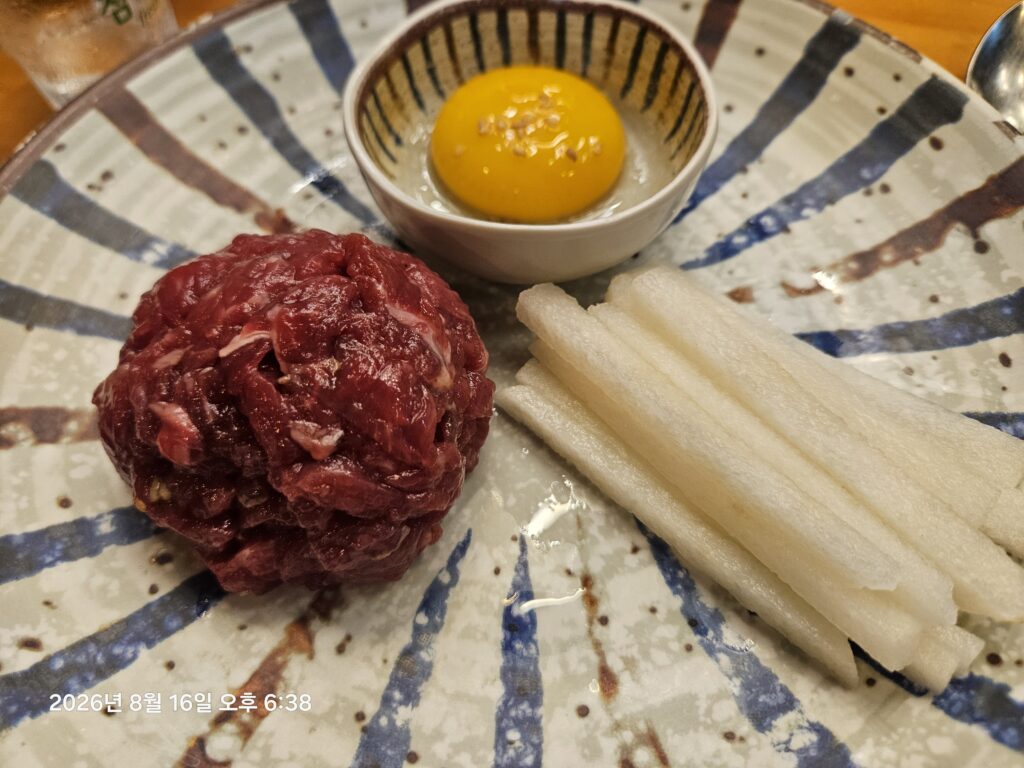
“Service.”
I guessed that the employee might have told the owner what had happened.
The Korean use of the English word “service” (서비스) can be a little confusing if you’re not familiar with it.
At Korean restaurants, when the restaurant gives you a free dish or drink that you didn’t order, you may hear someone say:
“This is service.”
In other words, it’s complimentary.
We hadn’t ordered the yukhoe, and we hadn’t asked for anything because of the spilled sauce.
So the plate was unexpected.
We thanked them and ate it.
And it was delicious.
It became a small story from our first visit to a restaurant we had been walking past for almost a year.
Our Korean BBQ Dinner Cost About 70,000 Won
That evening, we ordered:
- Four servings of dwaeji galbi
- Three bottles of soju
- One bottle of beer
The plate of yukhoe was complimentary.
Our total bill for the three of us was around 70,000 won.
Restaurant prices in Korea have risen quite a bit, so these days I pay attention to how much eating out costs too.
One reason we had noticed this restaurant after moving to the neighborhood was that it always seemed busy while its prices looked relatively affordable.
After finally eating there, I could understand at least part of the reason it was so popular.
Of course, 70,000 won is not some standard price for Korean BBQ in Korea.
Prices can vary significantly depending on the city, neighborhood, restaurant, type of meat, and quality.
This is simply what our family of three actually ate and paid at a neighborhood pork BBQ restaurant in Korea in the summer of 2026.
And Somehow, Our Walk Turned Into Bingsu
By the time we finished the pork, I think my wife had mostly forgotten about our original plan to go for a walk.
Our child needed to use the restroom, so we went to find one nearby.
While that was happening, another idea apparently entered my wife’s head.
Bingsu.
So instead of going to the park, we went to eat bingsu (빙수), a Korean shaved-ice dessert.
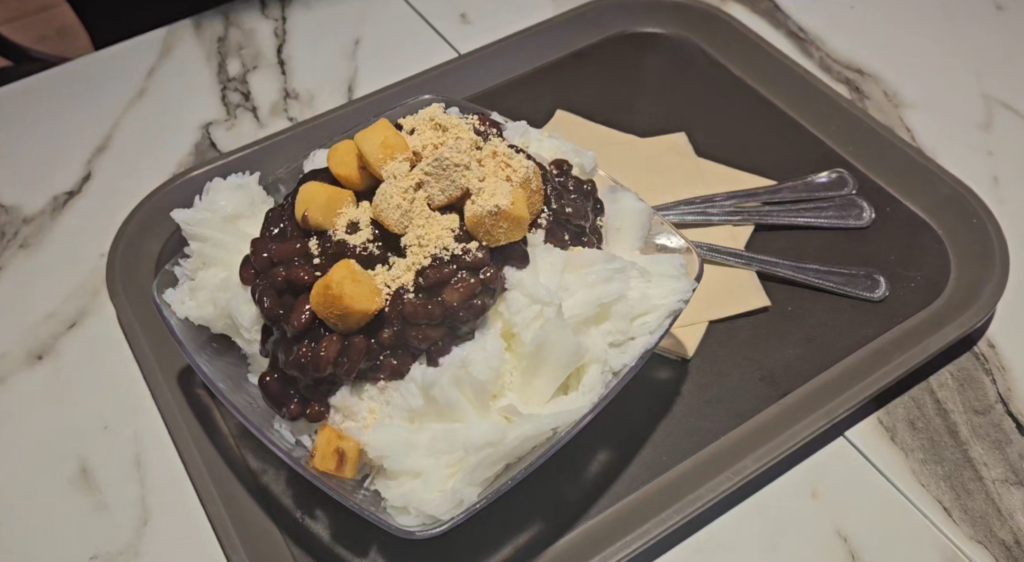
After finishing it, we walked home.
It took about 15 to 20 minutes, so I suppose we got at least part of our walk after all.
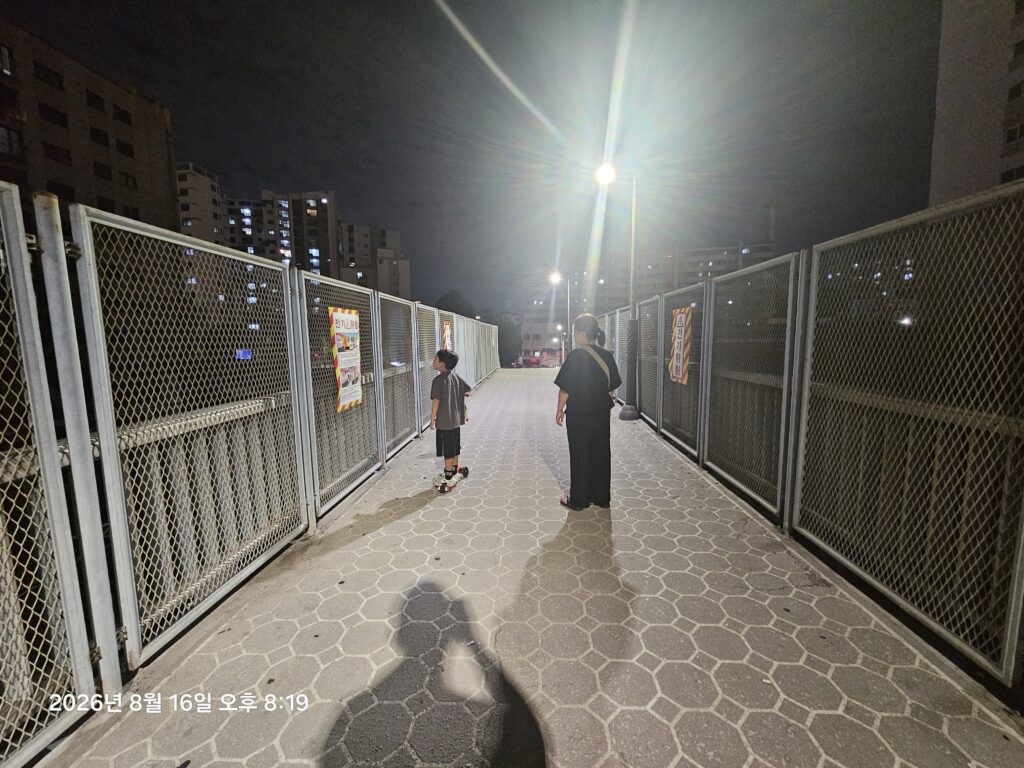
Looking back, almost nothing about that evening went according to plan.
We left home to eat tteokbokki.
The restaurant was closed.
So we ate dwaeji galbi.
We drank soju.
We unexpectedly got a plate of yukhoe.
Instead of going to the park, we ate bingsu.
And then we walked home.
It wasn’t a special occasion.
It was simply the last evening of our vacation, and our family had gone out for dinner.
What Korean BBQ in Korea Is Actually Like
If you’re experiencing Korean BBQ from outside Korea, things like the charcoal grill, banchan, ssam, garlic, and soju might each seem like distinct pieces of Korean culture.
To me, they’re so familiar that I normally don’t even think about them.
Ordering dwaeji galbi.
Grilling the meat.
Making your ssam however you like it.
Having a glass of soju.
Talking with your family while you eat.
That evening didn’t feel like a “Korean BBQ experience” to me.
It was just dinner with my family.
But maybe the ordinary things I barely notice anymore are exactly the things someone curious about Korea might want to see.
Not Korean BBQ prepared as an experience for tourists.
Just Korean BBQ in Korea, the way one Korean family actually ate it at a neighborhood restaurant.
That’s all our dinner was.