Korean apartments are a huge part of everyday life in Korea, but I actually grew up living in houses rather than apartments.
So I don’t really have any special childhood memories of apartment living.
My first real experience with something similar came when I moved out on my own and lived in an officetel in Songpa-gu, Seoul.
An officetel isn’t exactly the same thing as an apartment in Korea.
But many of the conveniences I experienced there for the first time were similar to what I now enjoy living in a Korean apartment.
Today, I live in an apartment.
And if an American asked me what Korean apartments are like, I probably wouldn’t describe them simply as tall buildings where many families live.
To me, a Korean apartment complex can feel more like a small living ecosystem built around your home.
Korean Apartments Are More Than Just Places to Live
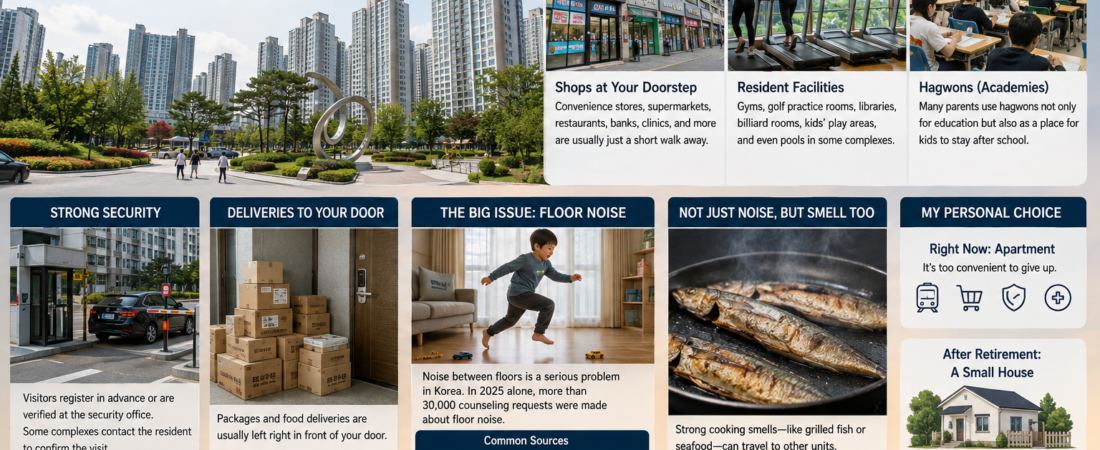
One of the first things you might notice when entering a Korean apartment complex is the landscaping.
There are trees and flowers, walking paths, and sometimes surprisingly elaborate sculptures or small garden areas.
In a large complex, it can feel less like several residential buildings standing next to each other and more like a space designed for residents to walk, relax, and spend time outside.
But there’s something even more important to everyday life.
The commercial buildings.
Many Korean apartment complexes have commercial areas nearby that primarily serve the people living around them.
The most basic businesses are convenience stores and supermarkets.
The reason is simple.
People have to eat every day.
Being able to walk a few minutes from your home to buy milk, water, ramyeon, snacks, or household supplies is more convenient than you might think.
Convenience stores are such a normal part of everyday life here that I’ve written separately about why Koreans rely on them so much.
And as a parent, there’s something else I consider important.
Hagwons.
Why Are There So Many Hagwons Around Korean Apartments?
You’ve probably heard that Korean parents care a lot about their children’s education.
And Korea does have a very high rate of participation in private education among elementary school students.
But as a parent raising a child in Korea, I see another practical reason too.
Time.
School ends much earlier than many parents finish work.
So where does a child go between the end of school and the time their parents come home?
Korea has public after-school care programs, and every family’s situation is different.
But in the world I see around me, a hagwon (학원) can serve two purposes.
It’s a place where children study, of course.
But it can also be somewhere a child spends part of the afternoon after school.
That’s one reason seeing hagwons in the commercial areas around apartment complexes feels completely normal to me.
I’m not saying this explains why Korea has so many hagwons.
It’s simply one practical reason I notice as a parent living here.
Restaurants are also common.
If the commercial area is large enough, you might also find clinics, pharmacies, banks, and other everyday services.
Naturally, businesses that residents need regularly tend to gather around places where thousands of people live.
Some Apartment Complexes Give You Fewer Reasons to Leave
In many newer, larger apartment complexes, the amenities don’t end with nearby shops.
Some have facilities specifically for residents, such as gyms, indoor golf practice areas, billiard rooms, laundry facilities, and children’s play areas.
Some very large complexes offer swimming pools or other recreational facilities as well.
Of course, not every Korean apartment has these things.
There can be major differences depending on the age, size, location, and price of the complex.
But when I look at newer apartment developments in Korea, it seems that the question is no longer only:
What kind of home will I live in?
There’s another question too:
How much of my everyday life can I take care of without going far from home?
Some Apartment Complexes Are Difficult for Visitors to Enter
Security is another convenience I notice about apartment living.
At some newer or more security-conscious apartment complexes, outside vehicles can’t simply drive in.
Residents may register a visitor’s license plate in advance through an app.
If a vehicle isn’t registered, security staff may ask which building and apartment the visitor is going to and why they’re visiting.
At some places, they may even contact the resident to confirm that the visitor is expected.
Security systems vary significantly from one apartment complex to another.
But after spending much of my earlier life in houses, this kind of shared access control feels like one of the noticeable differences of apartment living.
And Yet, Packages Are Just Left Outside Your Front Door
This part might seem a little interesting to someone from another country.
An apartment complex can be quite careful about who gets through the entrance.
But once a package has been delivered inside, it’s very common to see it sitting right outside someone’s apartment door.
Many apartment buildings have parcel lockers.
But in my own daily life, most packages I see are simply delivered all the way to the front door.
Food delivery works the same way.
When I order delivery food in Korea, my normal expectation is that the delivery driver will bring it to my apartment door.
Sometimes you’ll also see a delivery driver unload a large number of packages for one apartment building and temporarily stack them together before making the individual deliveries.
There can be quite a pile of boxes.
Most people simply walk past without paying much attention to them.
I’ve seen American videos on YouTube about so-called porch pirates—people stealing packages after they’ve been delivered.
Whenever I see those videos, the scene feels quite different from what I see in my everyday life in Korea.
Of course, theft exists in Korea too.
I’m not saying packages never disappear here.
I’m simply saying that in my own experience, leaving a delivered package outside an apartment door is completely ordinary.
If Apartments Are So Convenient, Why Can They Feel Restrictive?
When it comes purely to convenience, I think apartment living in Korea is extremely comfortable.
From taking out the trash to security, transportation, education, medical care, shopping, and delivery, many things you need in everyday life are easy to access.
So if you asked me to choose between a detached house and an apartment in Korea right now, I would probably choose the apartment.
But apartments have an obvious downside.
You aren’t living alone.
And there’s one problem that’s difficult to avoid when talking about apartment life in Korea.
Noise between floors.
Noise Between Floors Is a Serious Issue in Korean Apartments
In Korea, the problem is commonly called cheunggan so-eum (층간소음), literally “noise between floors.”
It’s not simply something I personally find annoying.
The issue is serious enough that Korea has a dedicated service for counseling and on-site noise assessments.
In 2025 alone, it received more than 30,000 phone and online counseling requests.
That’s an indication of how many people deal with this issue in real life.
Living in an apartment naturally makes me more conscious of the noise I make.
But there’s another difficult part of the problem.
If you hear repeated thumping sounds in your home, you can’t necessarily be certain that they’re coming from the apartment directly above you.
In a multi-unit building, sound can travel through the structure.
But when someone has been suffering from noise for a long time, it’s easy to suspect the upstairs neighbor first.
And that’s where conflicts between neighbors can begin.
In Korea, there have even been cases where disputes over apartment noise escalated into serious crimes.
So when you live in an apartment, you inevitably become somewhat conscious of what you’re doing inside your own home.
Just because it’s my home doesn’t mean I can do absolutely anything I want without thinking about my neighbors.
Sometimes Your Neighbors Can Even Figure Out What’s for Dinner
Noise isn’t the only issue.
There’s also smell.
Imagine grilling fish or cooking seafood with a strong smell at home.
That smell can sometimes travel to other apartments.
And then a post may appear in the apartment residents’ online community.
“Someone seems to be grilling fish.”
Sometimes you can see a complaint before you’ve even finished eating.
And that’s when you might think:
Do I really have to worry about what other people think even when I’m cooking dinner in my own home?
There’s a Korean expression that fits situations like this very well:
nunchi (눈치).
It’s difficult to capture perfectly in one English word, but in this situation, it means being conscious of how other people might perceive what you’re doing—and adjusting your behavior because of it.
Korean apartments can be incredibly convenient.
But when so many people live so close together, being conscious of your neighbors is part of the deal.
Even So, I’d Choose an Apartment Right Now
I currently live in an apartment.
And if you asked me today to choose between an apartment and a detached house in Korea, I’d choose the apartment.
It’s simply too convenient.
Transportation, shopping, education, hospitals, delivery, security.
For someone like me living an urban life in Korea, giving up all of that convenience would be harder than it sounds.
Of course, I’m not saying every Korean prefers apartments.
Many people live in villas and other types of multi-family housing, and some people prefer detached houses.
This is simply my choice.
But interestingly, if you ask me where I’d like to live after retirement, my answer changes.
After I Retire, I’d Like a Small House With My Wife
Someday, when I stop working and retire, I’d like to try living in a small detached house with my wife.
I think I’d be okay with a little inconvenience.
Everything wouldn’t need to be as close as it is when you live in an apartment.
What I want is actually very simple.
I’d like to live while worrying a little less about everyone around me.
I wouldn’t want to think about whether the sound of my footsteps bothers someone downstairs.
I wouldn’t want to worry about whether the smell of the food I’m cooking bothers someone else.
I’d like to live a little more on my own terms.
Of course, reality probably wouldn’t be that simple.
Theft and other crimes exist in Korea too, and a detached house in a less populated area can bring different security concerns from an apartment.
Maybe after giving up apartment convenience, I’d finally realize just how many things I’d been taking for granted.
So I don’t know whether I’ll actually choose a detached house when I retire.
But that’s what I imagine now.
For the life I’m living in Korea today, an apartment is incredibly convenient.
And someday, when my life slows down a little, I’d like to live a slightly less convenient life in a small house with my wife.